Concrete retaining walls in Portsmouth NH - a wall that drains and stays put
Soil washing down or an old wall starting to lean? We pour a concrete wall with a solid footing and drainage built in.
- Fully licensed and insured.
- Free estimates at your property.
- We respond within 1 business day.
What goes into a concrete retaining wall that lasts in Portsmouth?
The short answer: A concrete retaining wall holds back the soil on a slope so your yard, driveway or patio stays where it is. In Portsmouth, that wall has to stand up to water pushing from behind and frost working under it, winter after winter.
Most people call us when a slope keeps dropping dirt onto the driveway, a backyard is too steep to use, or an old timber or block wall has started to lean. The price comes down to how long and tall the wall runs, how deep we dig for the footing, how water will leave from behind it, and how easily we can get a truck and crew to the spot, so a tight side lot usually costs more to build on than an open yard. The schedule turns on the season, because fresh concrete can't be left to freeze, and on whether your lot needs a city review before anyone disturbs the ground. Once I've seen your slope, the written estimate spells out what your wall needs and what that comes to.
How do you know your slope or old wall needs attention?
An old wall leaning out
When the top of a wall tips toward you or the middle starts to bulge, the ground behind it is winning, and trapped water is usually part of why. Every freeze and thaw pushes it a little farther, and a wall that lets go takes the slope down with it.
Dirt washing onto the driveway
If mud and mulch end up on the driveway or walk after every heavy rain, the slope above has nothing holding it, or what's there has failed at the bottom. Each storm takes a little more, and it can start to undercut the edge of the slab below.
Wet streaks on the wall
A face that stays dark and damp, or white crusty streaks around cracks, means water is getting through the wall instead of draining around it. That water freezes in the cracks each winter and opens them wider until patching won't hold.
How we build concrete retaining walls
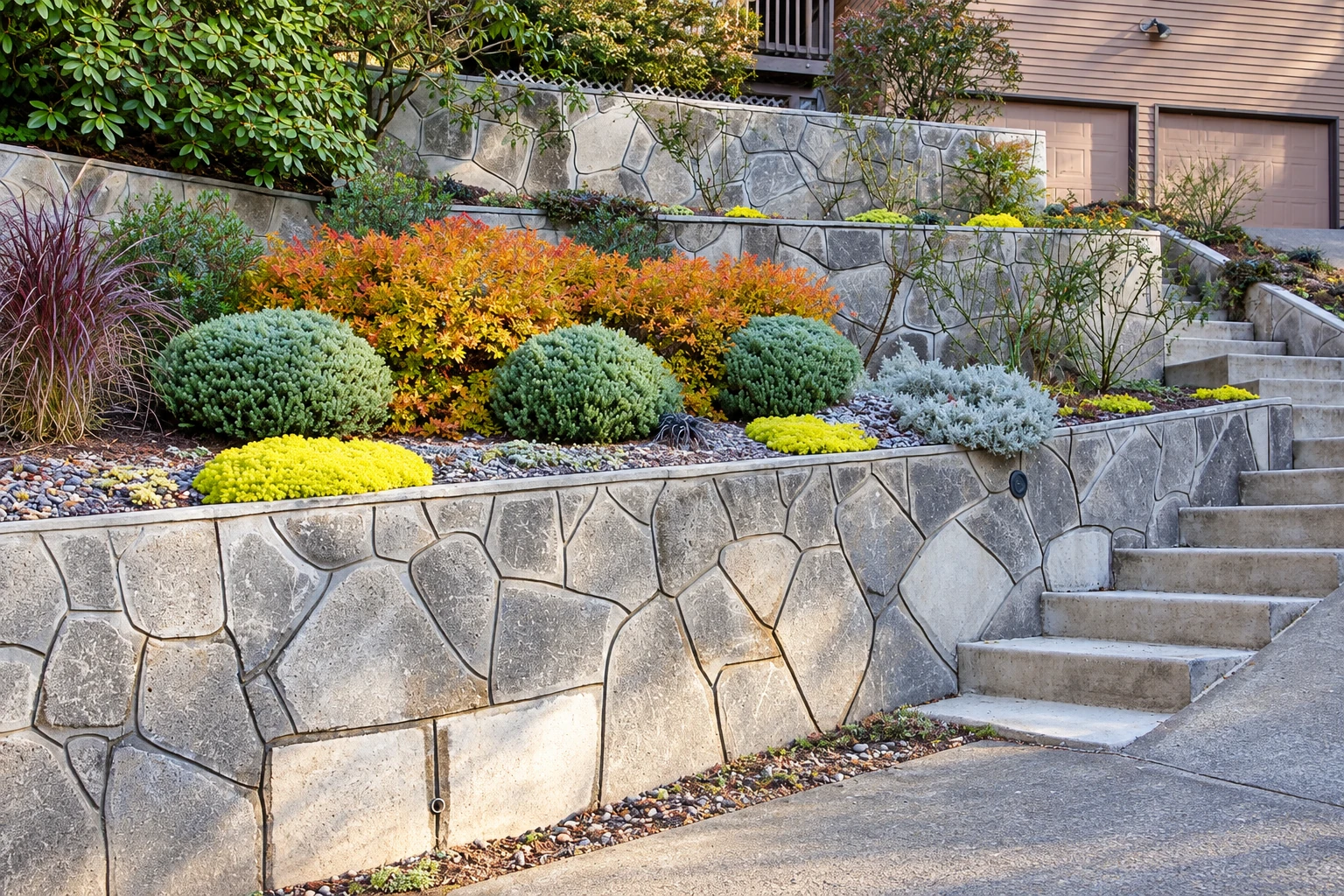
We don't price a wall by its height, because the drainage behind it and the footing under it do most of the work, and your quote shows how water will get out from behind the wall. On the job we lay out the line, dig down for the footing and set the rebar, steel bars that tie the footing and wall together so the concrete doesn't crack apart under the push of the ground. We pour the footing, form and pour the wall on top of it, then backfill behind it with drain stone wrapped in filter fabric and a perforated pipe that carries water out past the end of the wall. Last, we grade the ground above so rain runs away from the wall instead of soaking in behind it, and we clean up. If the budget gets tight, I'd rather trim the finish on the face than the drainage or the footing, because you can change how a wall looks later but you can't fix what's buried under it without tearing it out.
A wall usually opens up room for something flat. Holding back the slope beside a pool is often what makes a level concrete pool deck possible, and when a wall lets us level part of a hill for an outbuilding, we can handle the concrete floor installation for that building too.
Reinforced wall on a full footing
This suits a wall holding up a driveway, a parking spot or a steep slope near the house, where the load behind it is heavy. It takes more digging and more steel, and that's money well spent where a failure would be expensive to fix.
Low wall for beds and terraces
A shorter wall works for squaring off a garden bed or stepping a gentle yard into flat levels you can actually use. It still needs a footing below the frost and a way for water to get out, just on a smaller scale.
What happens when you call about a retaining wall in Portsmouth?
Here's how a wall job goes with us, from the first call to the day the forms come off and the yard is cleaned up. Planning and permits come first, before anyone digs.
- Step 01
Call or send us a message
Call (603) 956-1034 or use our form, and tell us roughly how long the slope runs and what's been happening. We'll get back to you to set up a time to look at it.
- Step 02
Walk the slope with me
I come out myself, walk the slope, look at where the water runs and ask how you'll use the space above and below the wall. You get a written estimate that breaks out the footing, the drainage and the wall itself, so you can see where the money goes and compare it with other quotes.
- Step 03
Settle permits and the date
Once you're ready, we sort out any permit questions and pick a pour date with the season in mind. If the weather is likely to change the plan, we'll tell you before the date is set.
- Step 04
Dig, pour, backfill, clean up
Our crew preps the base, pours and finishes the wall, and backfills it the way your estimate lays out. When we leave, the ground is graded and the site is cleaned up.
What changes a concrete retaining wall job in Portsmouth
Lots near water are the big local question. The city's wetland buffer reaches 100 feet out from Portsmouth wetlands larger than about a quarter acre, and that includes most tidal areas, so plenty of yards near the water fall inside it. New construction, digging or moving fill inside that buffer needs a Wetland Conditional Use Permit from the city's Planning Board, and the Conservation Commission reviews every one of those applications as well, so plan on two boards looking at it. You can check your lot on the city's wetland buffer map. For a wall outside the buffer, we don't assume either way. Before we set a pour date, we check what the local building office needs and help pull together the sketches, site plans or drawings they ask for, and if your property sits in a historic or flood area, we plan around that review from the start.
Frost is the other thing here. One frost-depth guide says New Hampshire winters bring weeks when the air stays below freezing, and frost reliably reaches four feet down in the south of the state. The bottom of a footing should sit at least two feet deep and always below the frost line, so on the Seacoast it usually ends up well past that minimum. We see the same hard winters on jobs in Dover and across the river in Kittery, since we work in the cities around Portsmouth on both sides of the Piscataqua, in New Hampshire and Maine.
Get a written estimate for your retaining wall
Send a few photos of the slope, a rough length and height, and whether your lot is near a wetland or the water, and we'll respond within 1 business day to set up a visit. I'll come walk the slope, then send a free written estimate, and there's no pressure to book.
Why Portsmouth homeowners call Portsmouth Concrete Works
I'm at your estimate and pours
I write the estimate myself after seeing your slope, our own crew does the work, and I'm on site for the pours. The person who planned the footing and drainage is the one watching them go in.
Awkward slopes since 2017
We've been in business since 2017, and the awkward jobs are the ones people call us for, sloped yards and tight side lots included. On a lot near the water, that same habit means we work out the wetland and shoreland questions before anything gets dug.
Fully licensed and insured crew
We're fully licensed and insured, which matters when a crew is digging deep beside your house, driveway or property line. Our work is backed by our satisfaction guarantee.
Most of what decides how long a wall lasts ends up buried, so have someone look at your slope before you pick a quote. Ask for an estimate or call (603) 956-1034.
Retaining wall questions we hear in Portsmouth
How much does a concrete retaining wall cost in New Hampshire?
Retaining wall construction in New Hampshire usually costs about $42 to $46 per square foot. That's the going rate across the state, not our price, and where your wall lands depends on the design, how hard the site is to reach and how much work the job takes. The written estimate after I've seen your slope gives you your own figure.
Why does drainage matter so much behind a retaining wall?
Water trapped behind a wall can greatly raise the load pushing on it and cause leaks and freeze damage, so drainage usually decides how long a wall lasts. It belongs in every quote you compare. If one doesn't say how water gets out from behind the wall, ask before you sign.
Can you pour a concrete retaining wall in winter in Portsmouth?
Yes, but only with protection, because fresh concrete that freezes can lose more than half its potential strength and won't be durable. It has to be kept from freezing until it gains early strength, about two days after the pour, so a winter wall quote should include that protection.
Do I need a state permit for a retaining wall near the water in New Hampshire?
You may, because the state's shoreland law requires permits to build within 250 feet of the reference line of public waterbodies. The state's environmental agency also says digging, fill or building structures in or next to wetlands and waterbodies often requires a state wetlands permit, on top of the city review covered above. If your lot is near water, mention it on the first call so we can raise it early.
How do I take care of a concrete retaining wall?
The usual advice is to look the wall over twice a year for cracks, bulging or water stains, and to clean out the weep holes, the small drain openings near the bottom, once a year. Keep plants trimmed back because roots can damage the wall, and fix small cracks right away before water turns them into bigger problems.
What is the best way to compare retaining wall quotes?
Compare quotes built on a design for your site, not on height alone, because a wall's footing, reinforcement and drainage have to come from a design or code. Check that each quote says how deep the footing goes and how water will get out. Ask too whether the mix uses entrained air, tiny bubbles that help concrete hold up to freezing and thawing when it's soaked and scale less from de-icing chemicals.
Concrete work that often goes with a wall
Concrete pool decks
Once the slope beside your pool is held back, a poured deck can sit level, pitch water away from the pool and give you room to walk.
Concrete floor installation
If cutting into a hillside makes room for a shed, shop or garage, the floor inside needs the same careful base and drainage as the wall outside.
Talk to us about your retaining wall
Calling before the ground freezes leaves time for any wetland review and a pour date that isn't racing the cold, so call (603) 956-1034 or use our form.